

Mercedes-Benz 170 SB
Save this Mercedes-Benz
With a free account you can keep an eye on it:
- notification of a price change or sale
- pre-market: see new cars before anyone else
- bid in the live auctions


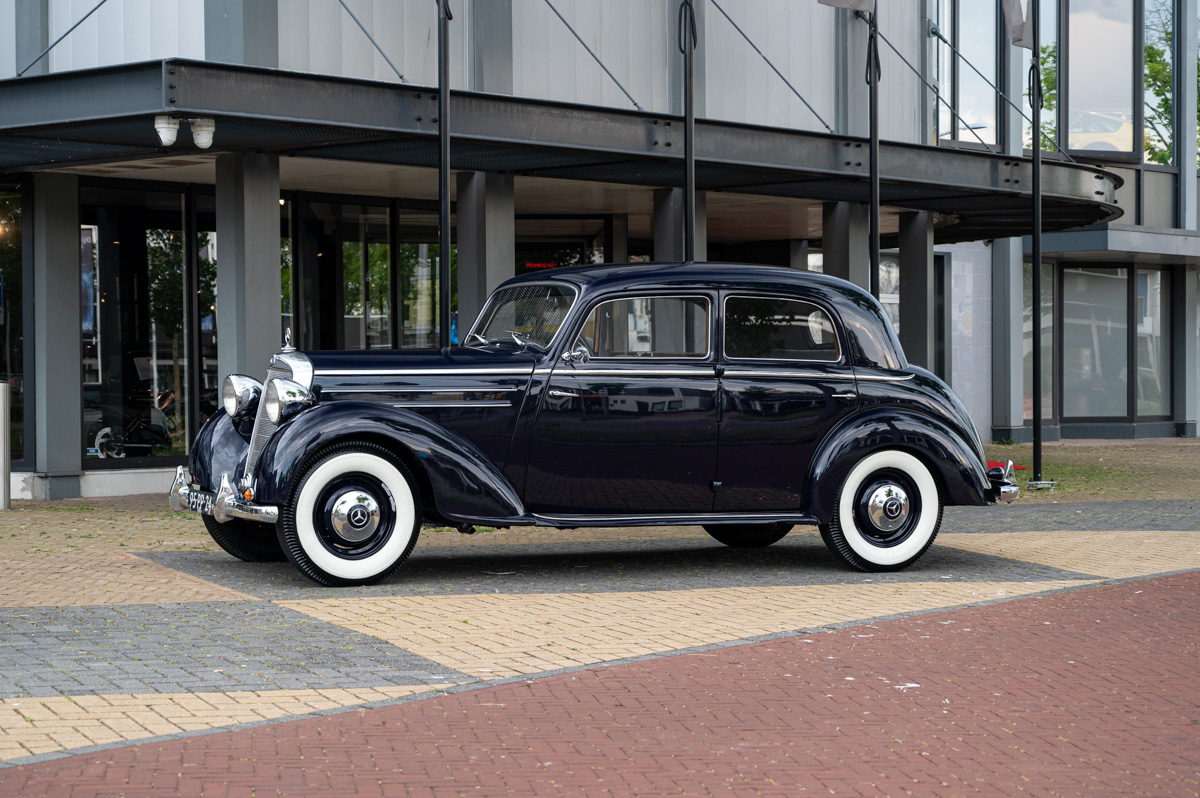
Picture the scene: a long leather coat, a fedora tilted just so, and a car that carries you across the country with an air of slightly dubious grandeur. Anyone who has watched a classic war film knows exactly the type. This 1952 Mercedes-Benz 170 S is the very embodiment of old-fashioned German engineering, and it was the successor to the 170 V, a car that Das Haus (as Mercedes-Benz is affectionately known) would rather not be reminded of.
The 170 S, to bring us back to the present for a moment, stood for comfort and solidity. Officially the car was called the 170SB, where the B stood for Benzin (petrol). There was also a diesel version in the range that needed no less than 56 seconds to reach 100km/h. An easy challenge on your souped-up e-bike. The petrol variant managed it in almost half the time, at which point we deliberately avoid the word 'fast'.
The 170 S offered here was bought 35 years ago by a collector from the collection of Mercedes specialist Piet Hommel in Waalwijk. Restored to the last detail at the time, driven regularly and still in fantastic condition. Although the RDW gives a registration date of 30 June 1951, this is the 1952 model year with the column shift, the chain-driven camshaft and the 'improved' heating.
Do apply a little 'Zeitgeist' to these improvements though: improving anno 1952 is a relative concept. As far as is known, just over 8,000 170SBs were made. Only a handful survive. The current owner bought the car in the autumn of 2025 and subsequently had it serviced for a sum of more than 14,000 by specialist Jaap Havik in Purmerend.
As the car stands now it is ready for hobby use, made as reliable as possible and still in perfect condition. A viewing will probably win you over on the spot, but if you would rather bring an expert along, they are most welcome to come and assess the 170S too.
The 170 SB does not ask for attention, but gets it anyway. At every classic car meet, at every petrol station, at every red light. People look, smile, give a thumbs up. Not because of horsepower or lap times, but because of beauty. Real beauty, the kind that does not age.


Looking for a Mercedes-Benz 170 (W136) yourself? What you need to know.
What should you look for when buying a Mercedes-Benz 170 (W136)?
The 170 (W136) is mechanically simple and robust. The greatest risks lie in the bodywork and the structure. Assess an example systematically.
Engine and drivetrain
- The M136 is a side-valve engine known for its reliability. Check for oil leakage, blue smoke and oil pressure at idle.
- Watch for coolant loss and the condition of the radiator; parts are available but not cheap.
- With the OM636 diesel: watch for hard starting, excessive smoke and even compression. A complete engine overhaul quickly runs into the thousands of euros.
- Test the four-speed synchromesh; difficult shifting or jumping out of gear indicates wear.
Bodywork and rust spots
- Pre-war versions are partly of composite construction, with wooden parts (including ash and beech) in the bodywork and interior such as the roof, A- and B-pillars and luggage floor; after the war this wooden construction remained reserved for the cabriolets. Rotten wooden parts require replacement and the services of a highly skilled woodworker in addition to the panelwork. This is a costly pitfall; a complete restoration often exceeds the market value. The chassis itself, incidentally, is a steel tubular backbone frame, not a wooden structure.
- Check the sills, floor pan and chassis rails for rot. On older Mercedes models, the sill together with its associated inner structure is usually the first to fail; when jacking at the fixed jacking points, a weakened sill may even collapse.
- Inspect the wheel arches, spare wheel well and the join between the longitudinal and cross members — known areas for corrosion.
- A thorough panel and welding restoration can cost tens of thousands of euros; always factor this in with project cars.
Interior and electrics
- Original upholstery, wood trim and instruments are value-determining. Replacement or restoration of the leather and headlining is costly.
- The 6-volt electrical system (depending on the year) is simple but susceptible to poor earths and old wiring; check the lighting, wiring and switches.
- Pay attention to the completeness of small parts; original trim pieces are scarce.
History and documentation
- Ask about matching numbers and check the chassis number (VIN) and engine number. Due to the overlapping type designations (170 V, Va, Vb, S, Sb, S-V), correct type determination is essential.
- For a restored example: ask for photographs of the process and invoices, particularly if the woodwork or bodywork has been addressed.
- A documented, maintained car is almost always the wiser purchase than a cheap project. Our examples, such as a 1951 Mercedes-Benz 170 SB with 31,772 km, have been selected for precisely that reason, on the basis of demonstrable condition and provenance.
Which Mercedes-Benz 170 (W136) suits you?
Which 170 suits you depends on your purpose. Those who wish to driving, are well and relatively affordably served by a sound 170 V or 170 S saloon; these are easy to maintain and offer the most classic-car enjoyment per euro. A diesel (170 D series) is a special choice with historical value, but slower and noisier.
Those who mainly want collect and focusing on retained value should look to the open versions: Cabriolet A, Cabriolet B and the rare Roadster. These are scarcer and more sought-after, but call for a considerably higher budget and extra attention to the structure. In all cases the 170 S offers more luxury and comfort than the 170 V.
Torn between driving and collecting, or between closed and open? HooG is happy to think along with you, without obligation, to find the right version to suit your wishes and budget.
What does a Mercedes-Benz 170 (W136) cost?
The European pricing picture in 2026 is wide and strongly dependent on bodywork and condition. Saloons form the accessible entry point, open versions the top segment.
Front 170 V and 170 S saloons the asking price in 2026 is typically between approximately €13,000 en €20,000 for projects and ready-to-use examples, rising to around €77,000 for very tidy, restored two-door 170 S saloons. A 170 S saloon will be offered in 2026 at around €20,000, while top examples of the 170 S approach €77,000. Diesels (170 Da/DS) occupy a comparable range and, for ready-to-use saloons, typically cluster around €20,000 to €50,000.
Open-top versions are considerably higher. A 170 S Cabriolet B will be offered in 2026 at around €107,500, and a pre-war 170 V Cabriolet A at around €92,500 to €119,500. The rare 170 V Roadster reaches asking prices of €80,000 to €245,000. Our own example, the 1951 Mercedes-Benz 170 SB with 31,772 km, offered at €57,500.
Price-determining factors are: body style (open over closed), originality and matching numbers, the quality of any restoration, documented history and the condition of the structure. Please note: the amounts quoted are indicative for 2026 and do not constitute a valuation.
Mercedes-Benz 170 (W136) — traded by us and in the collection
Questions about the Mercedes-Benz 170 (W136)
Looking for a Mercedes-Benz 170 (W136)? We find it — often before it goes online.
The best examples change hands before they are ever advertised. With a search request we search for you in our own collection and in our network of marque specialists and private collections in 23+ countries. Free and without obligation.
Your search request has been received
We will be in touch within one working day about your wishes and an honest market overview. Then we start searching — and only come back to you with examples that are right.